
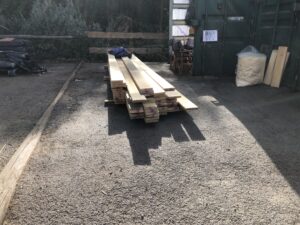
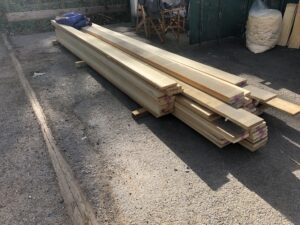
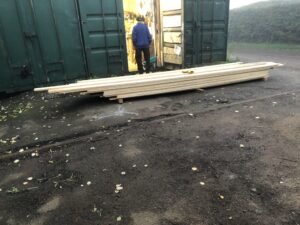
The timber used for the arrow shaft I produce at this time is Scots Pine (Scandinavian Redwood) structural grade finishing timber. The supplier(s) only supply me with FSC & PEFC certified timber. Chris used Scots Pine for over 30 years after spending 2-4 years of research and development when he first started to work out what was the best timber to use for arrow shafts. With that knowledge and info that is why I use the same timber.
Some thing to consider with regards the timber used by Dal’s Archery, it should not be grouped with other Pine shafts. Norwegian Pine is a different timber and a different tree all together. You will find Norwegian Pine to be much light and can act differently to Scots Pine shafts. With regards to Spruce shafts these are as light as Norwegian Pine if not a little more lighter. Due to the fibre structure with in Scots Pine (Scandinavian Redwood) used by Dal’s Archery you will find that arrows shafts are a little more durable, but this is only if the shafts are matched to you and your shooting style.
Information of the difference between Northern Pine & Scandinavian Redwood. All info taken from Google AI searches.
Some thing to bear in mind when looking at when looking online retailers or talking with shops/ fletchers etc, they may talk about the different woods for arrow shafts. A lot will batch ‘Northern Pine’ in with Scandinavian Redwood. These are actually not the same, see below information from a Google AI search that anyone can do.
ALL the Scandinavian Redwood I use comes mainly from Sweden not Russia.
Northern Pine is a more generic, or sometimes specifically North American, term often used for faster-grown, less dense pine used for general construction (often referred to as ‘whitewood’ or general spruce/pine/fir in many markets).
- Scandinavian Redwood: Because it grows in cold, northern boreal forests, this pine grows slowly. This slow growth results in tight annual rings and higher density. It is considered quite durable for a softwood.
- Northern Pine: Generally, “northern” or North American pine species tend to be faster growing, resulting in lower density, wider grain spacing, and less natural durability compared to Scandinavian-grown counterparts.
- Scandinavian Redwood: Exhibits a noticeable reddish/amber colour in the heartwood. It often has smaller, tighter, and more frequent knots.
- Northern Pine: Usually lighter in colour, ranging from creamy white to pale yellow.
- Scandinavian Redwood: Known as the “Joiner’s Choice” in the UK for furniture making, high-quality timber cladding, and joinery. It machines well to a smooth finish. Northern Pine: Frequently used in general building, framing, and DIY, often in situations where structural strength is prioritized over aesthetic finish.
| Feature | Scandinavian Redwood | Northern Pine (General/General) |
|---|---|---|
| Species | Pinus sylvestris (Scots Pine) | Often Pinus or Spruce (SPFs) |
| Growth Speed | Slow | Fast/Moderate |
| Density | High (for softwood) | Moderate/Low |
| Colour | Reddish/Amber | Creamy White/Yellow |
| Best Use | High-end Joinery, Furniture | Construction, Framing |
| Stability | Very Stable | Prone to movement |
- Canada: Newfoundland, Gaspé peninsula of Quebec, Ontario, and southeastern Manitoba.
- Northeastern U.S.: Maine, New Hampshire, Vermont, Massachusetts, New York, Pennsylvania, and West Virginia.
- Great Lakes Region: Minnesota, Wisconsin, Michigan, and northern Illinois.
- Appalachian Mountains: Extending south to Virginia, northern Georgia, and northwestern South Carolina.
- Michigan: Estivant Pines, Huron Mountains, Porcupine Mountains State Park, Sylvania Wilderness Area (Upper Peninsula), and Hartwick Pines State Park (Lower Peninsula).
- Minnesota: Lost 40 Scientific and Natural Area (SNA) and Boundary Waters Canoe Area Wilderness.
- Pennsylvania: Cook Forest State Park, Hearts Content Scenic Area, and Anders Run Natural Area.
- Canada: Algonquin Provincial Park and Quetico Provincial Park in Ontario, and along the Sainte-Marguerite River in Quebec.
- North Carolina: Great Smoky Mountains National Park.
- Europe: It has been introduced as an ornamental and is naturalizing in the Carpathian Mountains of the Czech Republic and southern Poland.
- Mexico/Guatemala: A variety known as Pinus strobus var. chiapensis grows in the mountains of southern Mexico and Guatemala.
- UK: Known as the “Weymouth pine,” it was introduced to the UK in the early 17th century.
Information of the difference between Norwegian Pine & Scandinavian Redwood. All info taken from Google AI searches.
- Scandinavian Redwood (General Term): Often refers to high-quality Pinus sylvestris imported from Sweden, Finland, or Russia. It is generally slow-grown, resulting in tight growth rings, high density, and durability, often used for joinery.
- Norwegian Pine/Redwood: Specifically grown in Norway, often in even harsher, colder climates, which can make it very slow-grown and dense. It is known for its reddish-brown heartwood and is excellent for structural and exterior use.
- Grading Difference: “Unsorted” Scandinavian Redwood is the highest quality (a mix of grades I-III), with fewer, smaller, and tighter knots. Lower-grade pine (often just called “pine” or “whitewood” in DIY shops) has more, larger knots and is faster-grown, making it less stable.
- Density and Growth Rings: Scandinavian Redwood grown further north or in higher altitudes generally grows slower. This slow growth produces tighter, more compact growth rings, making the timber stronger and less prone to warping compared to faster-grown pine.
- Durability and Treatment: Both are considered “slightly durable” in their natural state but take treatment very well. However, the higher-density, slow-grown, tighter-ringed Swedish or Norwegian Redwoods are generally better suited for exterior use, such as decking and cladding, compared to fast-grown, lower-grade alternatives.
- Appearance: Scandinavian Redwood often has a noticeable reddish-brown or yellowish-brown heartwood, with a creamier-coloured sapwood, whereas other pines (like SPF or “whitewood” spruce) are much lighter in color.
- Knots: High-quality Redwood (Unsorted) will have fewer, smaller, and fewer “dead” or loose knots than lower-grade pine.